www.derdiewas.de - Die Website zum Buch von David Bergmann
Navigation 1
Take me to your Umlauts! - page 1.3
At a closer glance, you can often find similar expressions in German, though not all of them have such grave consequence as in the case above. Some of them are just unintentionally amusing, for example:
“Der Mann ist ganz schön hässlich.” (The man is beautifully ugly.)
“Sie besucht einen Crashkurs gegen Flugangst.” (She is taking a crashcourse on the fear of flying.)
“Der Bundestag tagte bis in die Nacht.” (The Bundestag met “dayed” into the night.)
“Cäsar kommt immer vor Dora und Emil.” (Caesar “Charlie” always comes before Dora “Delta” and Emil “Echo”.)
“Dass er das ganze Geld einsackt, kommt bei mir nicht in die Tüte.” (It’s not my bag that he bagged all of the money.)
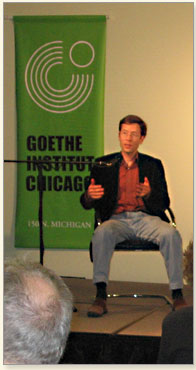
Every German knows the saying, “Deutsche Sprache, schwere Sprache” (German language, difficult language), but few Germans realize they equally correctly declare, “Deutsche Sprache, spaßige Sprache!” (German language, fun language!) I find this absolutely unacceptable! It’s about time for someone to do something about the bad reputation of the German language! Perhaps a very curious American of German descent?
And coincidentally, I happen to be just such a very curious American of German descent. Hence this book, in which 26 surprisingly painless chapters describe not only what German grammar looks like through a pair of foreign eyes, but also how an American - whose 32 great- great- great-grandparents emigrated from Germany to the U.S. in the middle of the 19th century - goes “back to the roots,” both physically as well as linguistically.
This collection of my impressions and experiences is meant to be pondered upon and, even more importantly, to be laughed about. It will reveal that German is not an awful language, as my fellow countryman Mark Twain once wrongly wrote, but rather awfully cool one!